

If you have ever checked your Google Search Console and seen traffic arriving from a source labelled “Discover,” you have already benefited from Google Discover for business without doing anything deliberate to earn it. Google Discover is one of the most misunderstood traffic channels available to content publishers today, and for business owners who invest in content marketing, understanding it can meaningfully shift how you think about your editorial strategy.
This article breaks down what Google Discover is, how it decides what to show, and what you can do to give your content a better chance of appearing in front of the right audience.
What Is Google Discover
Google Discover is a content feed built into Google’s mobile app and the Chrome browser on Android and iOS devices. Unlike traditional search, it does not require the user to type a query. Instead, it surfaces articles, videos, and web pages that Google’s algorithm predicts a specific user will find relevant, based on their browsing history, app usage, and location data.
Discover traffic is pull-based rather than push-based. You do not bid for placement. You do not target a keyword. Google makes the decision on your behalf, based on whether your content meets its quality and relevance thresholds.
How Google Discover Works
Google Discover does not rely on a keyword match between your content and a user’s search history. It operates on a signals framework that considers what a person cares about, how they have behaved across Google’s products, and how your content has performed with similar audiences in the past.
How Google Selects Content for Discover
Google’s own documentation describes Discover as being driven by topics the user has shown interest in, rather than queries they have typed. When your content is indexed and meets Google’s quality benchmarks, it enters a pool of eligible articles. From that pool, Google matches your content against the interest profiles of users it believes are likely to engage with it. Content that earns strong engagement signals, including long dwell time, saves, shares, and low bounce rates, tends to be shown to progressively larger audiences.
The Role of Signals and User Behaviour
An article that users read to completion, save, or share signals to Google that the content matched the intent of the audience it was served to. That positive signal can trigger a distribution expansion to a broader audience. Conversely, content that earns high impressions but low click-through rates sends a negative signal. Google Discover SEO is therefore not purely about on-page optimisation. It is about producing content compelling enough that users actually want to read it and stay long enough to demonstrate it delivered on its promise.
Why Google Discover Traffic Matters for Your Business
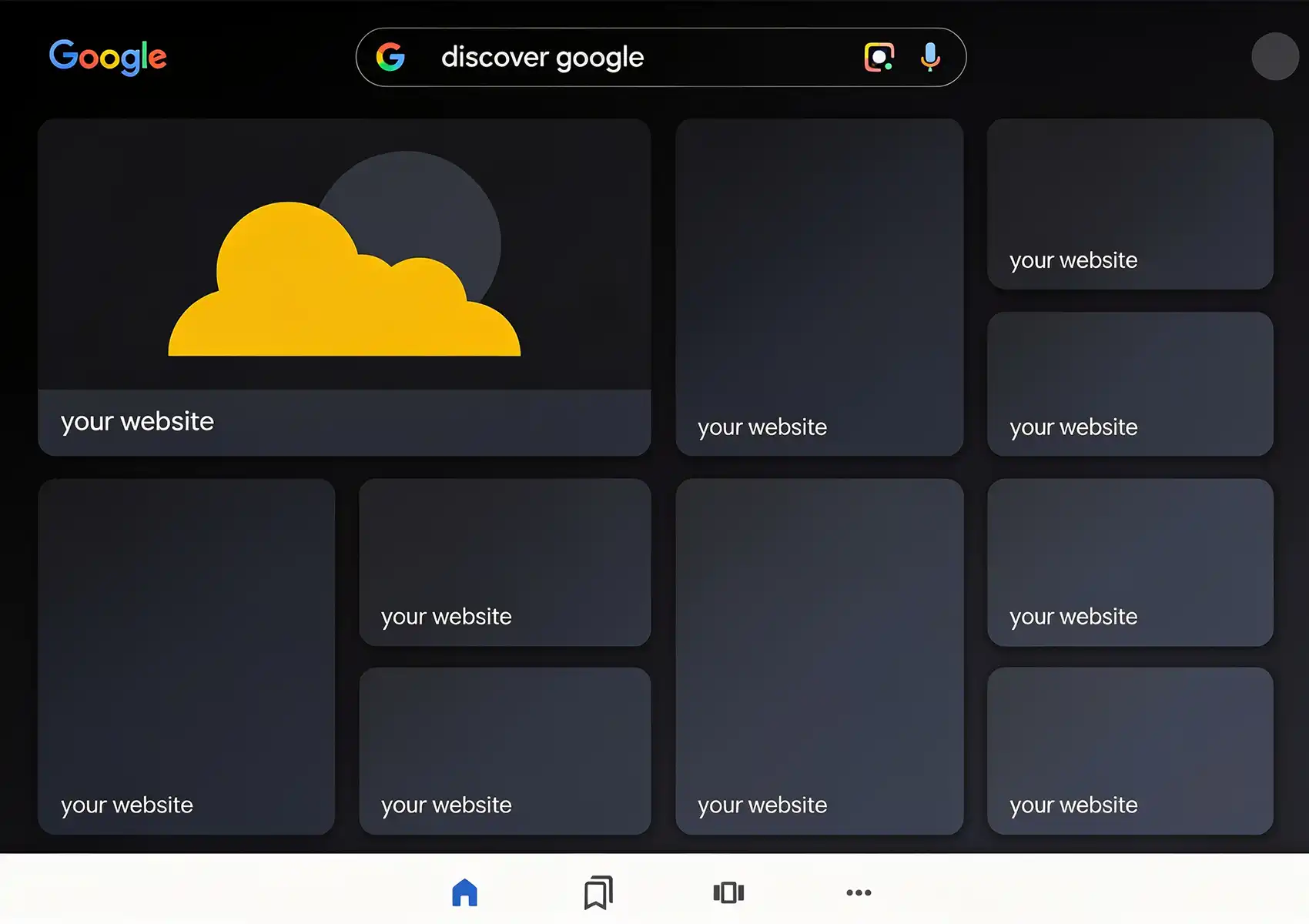
For businesses that rely on content marketing as a growth channel, Google Discover represents a meaningful opportunity that sits entirely outside the traditional paid-versus-organic debate. It is a zero-cost distribution mechanism for existing content. The challenge is that Discover traffic behaves differently from search traffic, and treating it as interchangeable leads to poor strategic decisions.
Google has publicly reported that Discover serves content to over 800 million users globally each month. For individual publishers, a single well-performing article can generate tens of thousands of visits in a matter of days, with no paid promotion involved. Discover spikes are often the largest single traffic event a website sees in a given month. They are unpredictable in timing, but they are not random. Content that consistently meets Google’s quality thresholds earns Discover placement at a far higher rate than content produced quickly or without editorial rigour.
Does Google Discover Work for All Types of Businesses
Discover favours content with broad consumer appeal. News, lifestyle, travel, food, health, and personal finance content performs well in Discover because these topics align naturally with the interest profiles Google builds from everyday browsing behaviour.
B2B businesses and highly specialised service providers can still appear in Discover, but the volume is typically lower and less consistent. Content that sits at the intersection of business strategy and practical advice tends to earn Discover placement more reliably than deeply technical or jargon-heavy articles.
Factors That Influence Google Discover Visibility
Earning consistent Google Discover traffic is the output of several content and technical factors working together. No single factor guarantees placement, but businesses that attend to all of them consistently build a measurable advantage.
Google Discover draws heavily on the E-E-A-T framework. Articles should be written by identifiable authors with real credentials, reference primary sources, and reflect genuine firsthand knowledge rather than a summary of publicly available information. Content should be grounded in valid data and real observations, not generic advice that could have been written from anywhere.
Images should be at least 1,200 pixels wide and enabled via the max-image-preview:large robots meta tag. The featured image is the first thing a user sees in the feed and carries a disproportionate share of the click decision.
Page experience signals, including Core Web Vitals, are a confirmed factor in Discover eligibility. Given that Discover is an exclusively mobile surface, mobile performance is not optional. A page that scores well on desktop but underperforms on mobile is effectively invisible to Discover.
Discover also rewards websites with established topical authority. Publishing at a predictable cadence, even a modest one, builds Discover eligibility faster than publishing in bursts followed by long gaps.
Optimise Your Content for Google Discover With Gaiada
Google Discover for business is not a channel you can buy your way into. It is earned through content quality, technical credibility, and a publishing strategy that builds topical authority over time. For business owners across Bali and South-East Asia, that represents a genuine competitive opening, because well-executed, data-backed content remains relatively rare in most local markets.
If your Search Console is showing inconsistent Discover results, or you have been producing content without a clear Google Discover SEO strategy behind it, there is performance on the table that you are not yet capturing.
Let’s start with a conversation about how to structure your current content to earn more consistent Google Discover traffic. Visit Gaiada.com to get in touch.


