

A/B testing for search ads is not the reason most Google Ads campaigns underperform. But it is almost always the reason they never improve. Every month, without a structured testing process, your budget is funding assumptions rather than evidence. That uncertainty is expensive, and it compounds quietly until the numbers become impossible to ignore.
A/B testing for search ads is what turns that uncertainty into data, and data into decisions that consistently lower your cost per acquisition. This Google Ads campaign experiments guide is built on what we have observed across accounts in Bali, Southeast Asia, and international markets: the advertisers that win are not the ones with the largest budgets. They are the ones who test deliberately and implement without hesitation.
What Is A/B Testing and Why It Matters for Search Campaigns
Most paid search accounts are optimised on instinct. A/B testing changes that. It gives you a controlled environment in which one variable is isolated, tested against a real baseline, and measured before any permanent change is made to a live campaign.
The Fundamental Definition of Split Testing
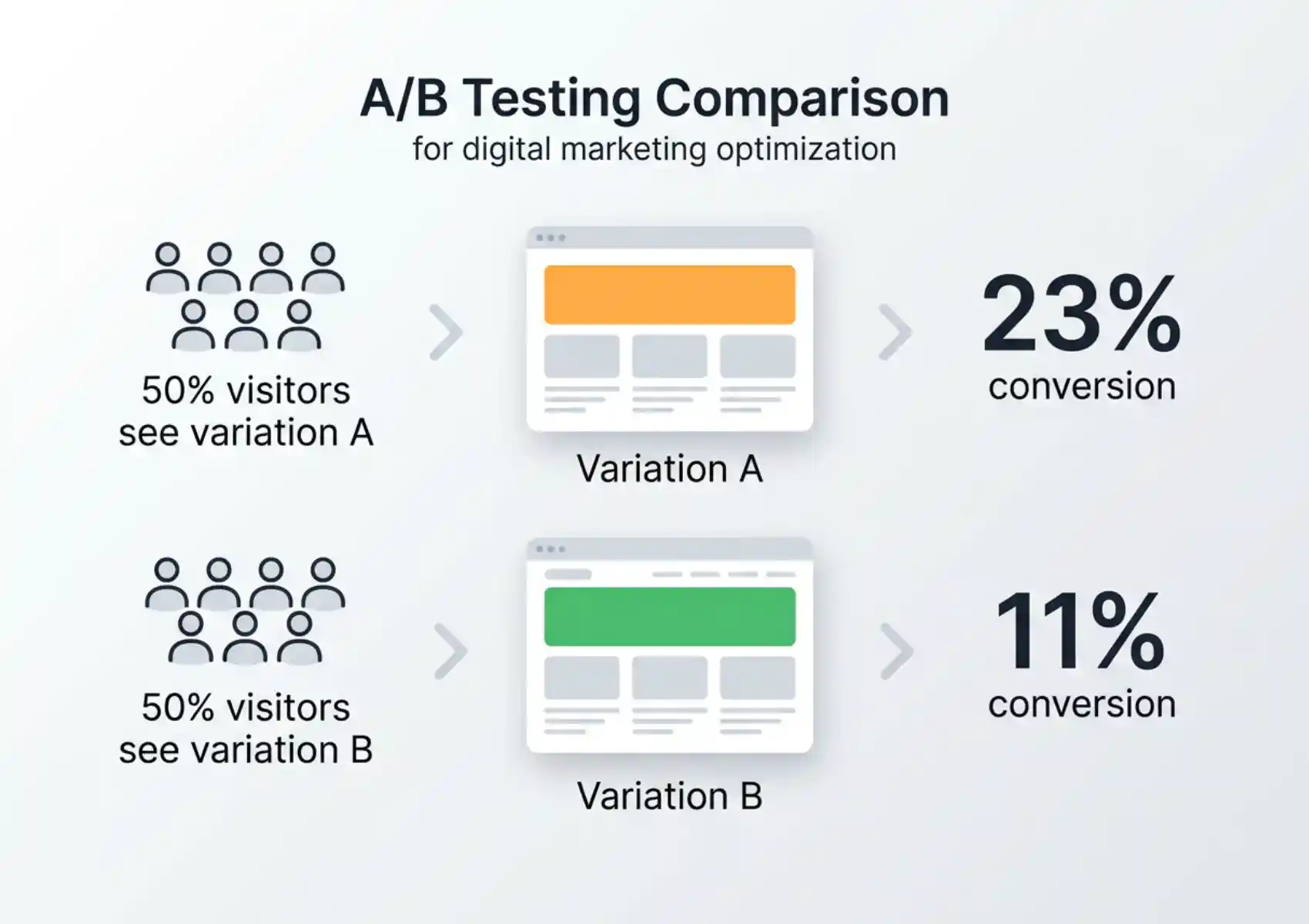
A/B testing is a strategy for collecting evidence about your audience’s preferences by providing them with two options. Some users see option A, whilst others see option B, and you compare performance metrics such as click-through rates and conversions to determine which performs better. The critical requirement is that options A and B are identical in every way except for the single variable you are testing.
Moving Beyond Guesswork in Paid Search Performance
The moment you conduct A/B testing for search ads in a structured way, you stop making decisions based on what feels right and start making them based on what the data actually shows. Not “I think version B sounds more compelling,” but “version B delivers 18 per cent more clicks at the same CPC, based on a solid data set.” In paid search, even a modest improvement in click-through rate compounds significantly across a monthly budget, and that is the kind of gain that builds over time.
How to Do A/B Testing via Google Ads Custom Experiments
Knowing how to run A/B testing in Google Ads requires more than just duplicating a campaign. Google’s Experiments feature provides a controlled, native environment to run split tests without disrupting your live campaign performance. Here is how we approach it for every new test we set up.
Establishing a Clear Strategy and Hypothesis
Every test needs a hypothesis before it starts. Not “let’s see what happens”, but a specific, directional prediction: “Adding a price point to the headline will increase the click-through rate by reducing unqualified clicks”. A clear hypothesis shapes what you measure, how long you run the test, and how you interpret the result when it ends.
Choosing the Right Test Elements within Your Campaigns
Not every element is worth testing. Focus on the parts of your ad that genuinely influence user behaviour. In Google Ads Experiments, you can test at campaign level, ad group level, or individual ad level, depending on the specific question you are trying to answer. We start every new client account with a prioritised test backlog that sequences elements by their estimated impact on conversion volume.
Allocating Budget and Setting Up Equal Traffic Splits
For a test to produce reliable results, both variants need equal exposure under equal conditions:
- Set your experiment to split traffic 50/50 between the original and the variant
- Run both variants simultaneously so that external factors such as day of week and auction fluctuations affect each equally
- Avoid unequal splits, as these introduce bias and make conclusions significantly harder to draw with confidence
Key Variables for Optimising Search Ad Variations
Optimising search ad variations is where the real performance gains are found, but only if you are testing the right elements in the right order. The variables you choose to test determine the quality of the insight produced. Testing the wrong things wastes time and budget. Testing the right things compounds performance improvement over months.
Optimising Headlines and Pinning Strategies
Headlines are the strongest lever available in a responsive search ad. Testing whether pinning a specific headline to position one improves or reduces performance is one of the most valuable experiments you can run, particularly for high-intent campaigns in which message consistency directly affects conversion quality.
Testing Dynamic Descriptions and Alternative Actions
Descriptions give you space to expand on the promise your headline makes. Test emotional versus rational copy, short versus long descriptions, and direct calls to action versus benefit-led statements. We have seen description tests in the travel and hospitality sector shift conversion rates by over 20 per cent simply by leading with a specific outcome rather than a generic service claim.
Evaluating the Impact of Different Landing Page Experiences
Your ad copy and landing page experience are inseparable within Google’s Quality Score framework. Testing whether two versions of ad copy perform differently when directed to different landing pages reveals both copy and page-level insights simultaneously. For accounts with sufficient traffic volume, this is one of the highest-value experiments you can run.
Crucial Rules for Maintaining Split Test Hygiene
Running a test is straightforward. Running a test that produces conclusions you can actually act on requires discipline. These two rules are non-negotiable in every experiment we set up at Gaia, regardless of account size or industry.
Testing a Single Variable at a Time for Maximum Clarity
If you change your headline, your description, and your call to action simultaneously, you will never know which change drove the result. One variable per test is not a preference. It is the only way to draw a conclusion worth implementing. We have had to rebuild testing programmes for new clients who had been running multivariate tests for months and could not confidently explain a single result.
Allowing Sufficient Time to Gather Useful Performance Data
Ending a test early because one variant is ahead is one of the most common and costly mistakes in paid search optimisation. As a practical guide, run each test for two to four weeks, or until each variant has accumulated at least 100 conversions, whichever comes later. Cutting a test short produces a result that looks like data but behaves like a guess.
How to Analyse and Understand Experiment Results
Understanding experiment results is where most advertisers fall short. Seeing a number move is not the same as understanding what caused it or whether it will hold at scale.
Identifying Statistical Significance in Your Core Metrics
Statistical significance tells you whether the difference between two variants is real or the product of random variation. Google Ads Experiments displays confidence levels directly within the interface. We do not declare a winner in any test we run until the result has reached at least 95 per cent statistical significance. Acting on results below this threshold is, statistically speaking, indistinguishable from guessing.
Reviewing the Broader Impact on Overall Account Efficiency
A headline that improves your click-through rate but attracts lower-quality clicks is not a genuine win. Always review your experiment results against the downstream metrics that actually matter to your business:
- Conversion rate
- Cost per conversion
- Quality Score movement
A test that improves click-through rate whilst damaging conversion rate has made your account more expensive, not more efficient. We identified exactly this pattern in a retail client account, where a high-performing headline variant was driving 30 per cent more clicks but converting at half the rate of the control, resulting in a net negative result that only became visible when the downstream metrics were reviewed alongside the headline data.
Selecting a Winner and Implementing the Successful Changes
Once a result reaches statistical significance and downstream metrics confirm the improvement, apply the winning variant as your new baseline. Document the result, the hypothesis, and the magnitude of improvement so that the learning feeds directly into your next test. Every completed test in our accounts informs the next hypothesis, building a continuous optimisation cycle that compounds performance quarter over quarter.
Optimise Your Advertising Return With Expert Performance Management From Gaiada
AB testing for search ads is not a one-time project. It is an ongoing discipline that separates accounts that improve from those that plateau. Running it well requires structured performance marketing analytics in Indonesia, especially for brands across Bali and Southeast Asia, which means accounting for local platform behaviour and audience patterns that differ meaningfully from Western benchmarks.
At Gaia Digital Agency, we manage structured A/B testing programmes as a core part of our Google Ads service, covering everything from hypothesis development to monthly performance reporting with full transparency. No guesswork, no wasted budget. Let’s start with a conversation about how to build A/B testing for search ads into your current Google Ads strategy.


